Why international golfers are looking beyond Thailand and South Korea — and landing in Vietnam.
A decade ago, if you asked a seasoned golf traveler where to plan their next Asian golf trip, Vietnam rarely came up in the first breath. Thailand had Hua Hin and Chiang Mai. South Korea had world-class resort courses packed with serious players. Japan had its legendary courses, even if tee times were almost impossible to get. Vietnam? It was still finding its footing.
That conversation has changed — and changed fast. Vietnam now operates approximately 100 18-hole golf courses, with new projects opening each year and more in the pipeline. A significant concentration of the highest-quality layouts runs along the central coastline. International golf travelers from Korea, Hong Kong, Singapore, and Europe are booking trips specifically to play courses here. Developers behind some of the world’s most respected golf brands have made Vietnam a priority destination. And the courses themselves — coastal links, mountain escapes, resort-quality parkland — are genuinely delivering.
This guide is for golfers seriously considering Vietnam as their next destination: what’s driving the growth, which regions offer the best golf, and what makes it different from anywhere else in Asia.
Why Vietnam — and Why Now?
Vietnam’s rise as a golf destination isn’t accidental. Several factors have converged to make it one of the most compelling places to play in Asia right now.
World-Class Course Design at Competitive Prices
Vietnam has attracted serious architectural talent. Nick Faldo, Greg Norman, Jack Nicklaus, Luke Donald, and Colin Montgomerie are among the designers who have put their names to courses here. The result is a roster of layouts that can compete aesthetically and technically with anything in the region — at green fees that remain competitive with comparable destinations.
At Da Nang’s top courses — Ba Na Hills, BRG Da Nang, Hoiana Shores — green fees typically run USD 120–180 per round, with weekends and peak season pushing toward the upper end. Japan’s resort-quality public courses generally start at a similar range on weekdays, but weekend and premium bookings climb considerably higher. For golfers who want to play multiple world-class rounds on the same trip, Vietnam’s combination of price, density, and course variety is genuinely hard to match.

Geography That Works in Golf’s Favour
Vietnam’s geography is genuinely unusual for golf. The country stretches over 1,600 kilometres from north to south, offering golfers a variety of terrain within a single trip that most destinations simply can’t match. You can play a coastal links-style course in the morning, with sea breezes pushing your ball sideways over dunescape, then drive inland to a mountain-framed parkland course with a completely different set of demands.
Central Vietnam — the stretch from Hue through Da Nang down to Hoi An — is where this contrast is most pronounced. This corridor of roughly 100 kilometres contains some of the country’s finest courses, all within easy driving distance of each other.
Improving Infrastructure and Connectivity
Da Nang International Airport now operates direct routes from Seoul, Hong Kong, Singapore, and several Chinese cities. Getting into central Vietnam has never been easier for the international golfer. Within the region, road infrastructure has improved considerably — drives between courses that once felt arduous now take 30–60 minutes.
Accommodation has kept pace. International resort brands — Banyan Tree, Angsana, Marriott, Pullman, and others — are now established in the region, giving golfers the kind of stay they’d expect anywhere else in Asia.
Vietnam’s Key Golf Regions: A Practical Overview
Vietnam is a long country, and not every region is equally developed for golf tourism. Here’s an honest breakdown of where to focus.

Central Vietnam: The Golf Heart of the Country
This is Vietnam’s premier golf region, and for good reason. The courses here are the most varied, the most internationally recognised, and the most consistently well-maintained. Da Nang serves as the gateway, with the airport and most of the hotel infrastructure — but the courses spread north toward Hue and south toward Hoi An.
Courses worth noting in this corridor include:
- Laguna Golf Lang Co — a Nick Faldo signature design built across dunes, rice paddies, and streams, set between the mountains and the East Sea coastline north of Da Nang. Widely regarded as one of Faldo’s finest designs globally, the course has a links-influenced out-and-back routing that plays very differently depending on wind direction.
- Ba Na Hills Golf Club — Luke Donald’s first-ever course design, located in the forested foothills about 25 minutes from Da Nang city centre. The elevation change across the layout and the cooler, shadier setting produce a round that feels genuinely different from the coastal courses nearby. It has won Asia’s Best Golf Course at the World Golf Awards multiple times.
- Montgomerie Links — a Colin Montgomerie-designed coastal layout with genuine links characteristics: firm fairways, wind exposure, and fast greens that demand creative shot-making.
- BRG Da Nang Golf Resort — a 36-hole beachfront facility and Vietnam’s only resort to combine courses from two of golf’s most celebrated designers: the Greg Norman Course (a links-style layout on sandy dunes, opened 2010) and the Jack Nicklaus Course (a Florida-inspired bulkhead design, opened 2018). Playing both in the same trip gives golfers two entirely different strategic experiences on adjacent sites.
A serious golfer can realistically play four or five rounds across genuinely different course types — links, mountain, parkland, and coastal — without travelling more than an hour between any of them. That kind of density is rare anywhere in Asia.
Hanoi and Northern Vietnam
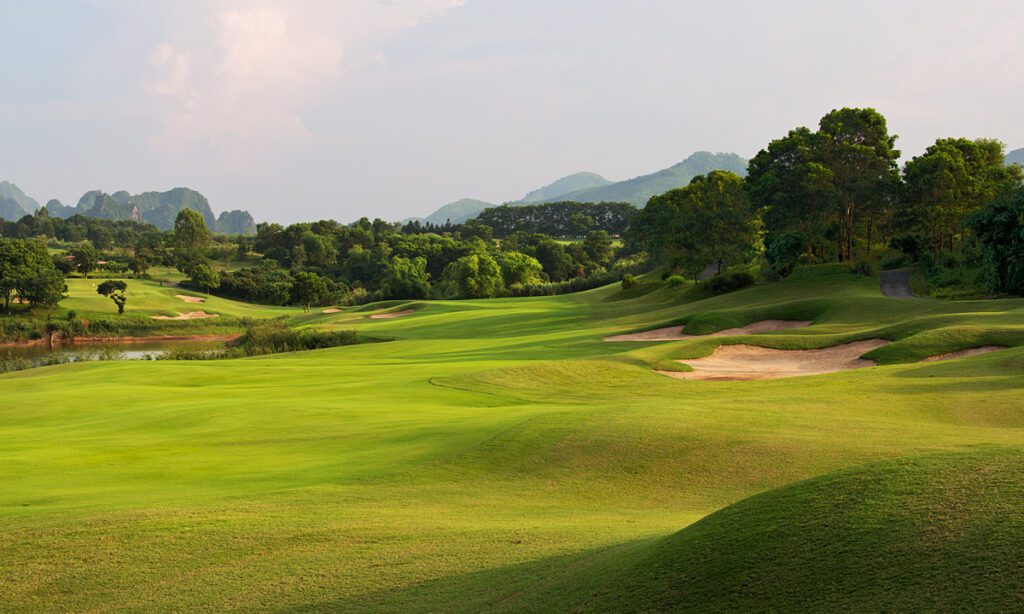
Hanoi has a solid cluster of golf courses within 30–60 minutes of the city, including long-standing layouts like BRG Kings Island Golf Resort and Sky Lake Resort & Golf Club. The capital attracts business travelers and golfers looking to combine a city experience with a round or two. The golf here is good — but it doesn’t have the coastal scenery or course variety of the central region.
For a dedicated golf trip, Hanoi works best as a starting or ending point rather than the main event.
Ho Chi Minh City and the South
Ho Chi Minh City has a significant golf scene, driven largely by the expat community and visiting business travelers. Courses like Long Thanh Golf Club and Vietnam Golf & Country Club offer quality rounds in well-maintained settings. The south also benefits from a more consistent dry season (November to April) during the months when central Vietnam can be at its most unpredictable. About 90 minutes southeast of Ho Chi Minh City, The Bluffs Ho Tram Strip — another Greg Norman design built across towering coastal dunes — is worth the detour for serious golfers and has been voted among Asia’s best courses.

How Vietnam Compares to Other Asian Golf Destinations
With Thailand, Japan, and South Korea all firmly established, what does Vietnam actually offer that the others don’t?
| Vietnam | Thailand | South Korea | Japan | |
| Green Fees (top courses) | USD 120–180 | USD 80–160 | USD 100–200+ | USD 100–250+ |
| Course Variety | High | High | Medium | High |
| Coastal Golf | Excellent | Moderate | Some | Some |
| Accessibility | Good (improving) | Excellent | Good | Moderate |
| Value for Money | High | High | Medium | Medium |
| English Service | Good | Good | Moderate | Variable |
* Green fees shown are for top-tier resort/championship courses per destination. Mid-range courses are available at lower prices across all markets.
The honest summary: Vietnam doesn’t yet match Japan for course conditioning standards or South Korea for the depth of golf culture. But it competes on value, scenic variety, and course design pedigree — and the overall travel experience around the golf is hard to beat. For golfers who want to play several rounds of genuinely world-class golf without the logistical complexity of Japan, Vietnam is the strongest case in Asia right now.
Best Time to Visit for Golf
Vietnam’s climate varies significantly by region, and getting the timing right is one of the most important planning decisions for your trip.
- Central Vietnam (Da Nang / Hue / Hoi An): The dry season runs roughly March to August, with March–May considered the sweet spot — temperatures are manageable (26–32°C), rainfall is minimal, and the coastal wind makes the links-style courses genuinely challenging without being brutal. Avoid October and November: this is peak typhoon and flood season for the central coast, and courses can close or become unplayable for days at a time.
- Northern Vietnam (Hanoi): October to December offers cooler, drier conditions and is generally the best window. Summer (June–August) is hot and humid. January and February bring a cool mist that some golfers find appealing, though it can reduce visibility on elevated courses.
- Southern Vietnam (Ho Chi Minh City / The Bluffs): The dry season runs November to April, making the south a reliable option during the months when central Vietnam is most at risk from weather disruptions.
If you’re planning a central Vietnam golf trip — which most visiting golfers will be — March through May is the window to target.
Practical Insights for International Golfers
Booking Tee Times
Most top courses in Vietnam now accept online bookings directly or through third-party platforms. Book at least 2–3 weeks in advance during peak season (March–May), especially for weekend rounds. Courses like Laguna Golf Lang Co and BRG Da Nang fill up quickly with Korean group bookings during this window. If you’re travelling solo or as a pair, weekday mornings offer the best combination of availability and pace of play.
Caddies and Cart Policy
Virtually every course in Vietnam assigns a caddie as part of the round — it is standard practice rather than an add-on, and it is worth embracing fully. Vietnamese caddies are generally excellent: knowledgeable about their courses, good at reading greens, and communicative even with limited English. A tip of USD 12–20 per caddie is standard and expected. Many top Da Nang courses now use an all-inclusive pricing model where the green fee covers a shared buggy and caddie service — confirm what’s included when booking.
Travelling with Clubs
Bringing your own clubs is straightforward on most international carriers serving Vietnam, though check baggage fees carefully — some low-cost carriers charge significantly for oversized items. All major courses have rental sets available if you’d prefer to travel light, though rental quality varies and custom fitting is not typically offered.
Getting Around
In Da Nang and the central region, hiring a private car and driver for the duration of your trip is highly recommended — and more affordable than you’d expect (typically USD 40–60 per day). Course transfers, airport runs, and restaurant visits all become dramatically easier. Grab works well within cities for shorter trips, but the distances to most courses make on-demand rides less practical for golfers with bags.
Do’s and Don’ts for Golf Travelers in Vietnam
Do:
- Book central Vietnam courses 2–3 weeks in advance during peak season — popular weekend tee times disappear fast, particularly at Ba Na Hills and BRG Da Nang.
- Tip your caddie well. USD 15–20 is the norm for good service, and a well-tipped caddie will often go well beyond basic bag-carrying to help your game.
- Plan for one course per day. Full 18-hole rounds here — especially on larger resort layouts — take 4.5 to 5 hours with caddies. Trying to squeeze in 36 holes will leave most golfers exhausted.
- Combine your trip with a cultural day. Hoi An’s old town, Hue’s imperial citadel, and the Hai Van Pass between Da Nang and Lang Co are all worth a half-day detour.
Don’t:
- Underestimate the heat. Even in the March–May window, midday temperatures in central Vietnam are intense. Tee off before 8am where possible and carry more water than you think you need.
- Ignore your caddie’s line on greens. Local caddies read the subtle breaks that aren’t visible to visiting golfers, and greens here — particularly at Ba Na Hills and Laguna — can be deceptive on first play.
- Assume card payments are universal. Larger resort courses accept cards, but always carry Vietnamese Dong (VND) as backup — smaller or older facilities may not.
- Book central Vietnam in October or November expecting reliable conditions. Typhoon season is real, flooding is a genuine risk, and courses can close without much notice during this period.
Final Thoughts: Is Vietnam Worth the Trip?
The short answer is yes — but with honesty about what it is and isn’t. Vietnam is not yet a fully mature golf destination in the way Thailand or Japan are. Service standards and course conditioning can be inconsistent outside the top tier. Green fees at the best courses are no longer the bargain they once were. And the weather window for central Vietnam requires real planning discipline.
But the upsides are significant and real: dramatic coastal and mountain landscapes that world-class designers have used intelligently; a course density in central Vietnam that lets you play very different styles of golf without moving hotels; a caddie culture that enhances the experience; and a country with enough history, food, and character to make the non-golf hours just as rewarding as the rounds themselves.
Vietnam is at a genuinely interesting moment: enough infrastructure and course quality to satisfy a serious international golfer, but not yet crowded or over-commercialised. That balance won’t last indefinitely. If you’ve been thinking about an Asian golf trip, this is a good time to go.